
FL Lic. #CMC1250863
First Degree provides commercial ductwork inspection, airflow diagnosis, repair, replacement, and modification planning for Palm Beach County buildings.
Commercial ductwork affects temperature control, pressure balance, equipment operation, indoor air quality, noise, and how reliably conditioned air reaches occupied areas. First Degree evaluates the reported problem in the context of the HVAC equipment, duct system, building use, access, and operating schedule.
Repair or replacement planning should follow observed duct condition, measured airflow or pressure information when applicable, equipment requirements, access limitations, and the needs of the occupied building.
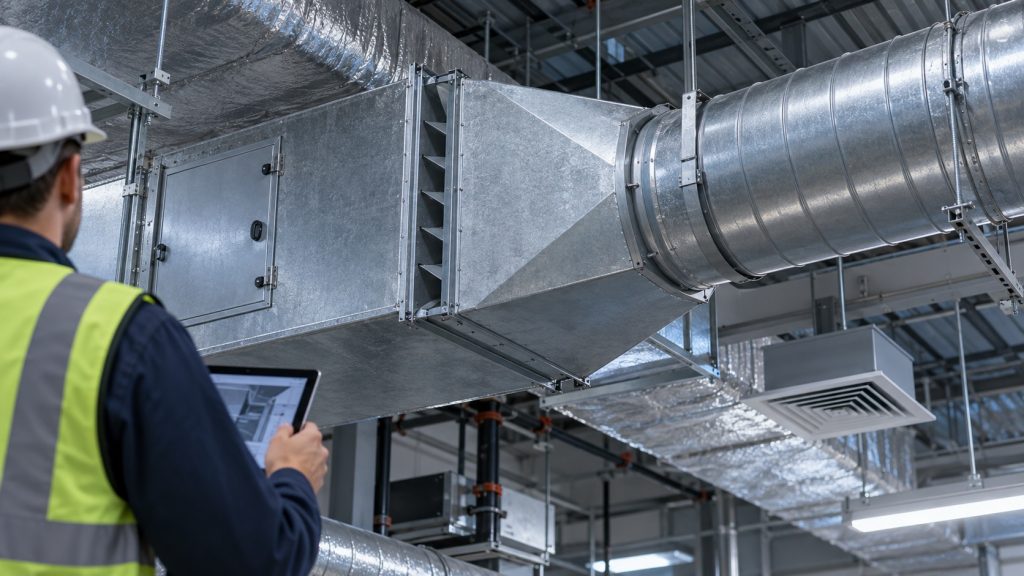
Each service path begins with the building, HVAC equipment, duct layout, access, and operating conditions rather than a room complaint alone.
Review accessible ducts, connections, supports, insulation, sealing, transitions, dampers, diffusers, returns, and visible damage.
Evaluate room complaints, supply and return pathways, equipment airflow, pressure relationships, controls, and operating schedules.
Plan sealing, connection, insulation, support, transition, damper, register, or localized duct repairs based on confirmed conditions.
Compare repair practicality, system layout, material condition, access, airflow requirements, phasing, and disruption before replacement.
Coordinate duct changes with tenant build-outs, equipment changes, room use, load requirements, controls, ceilings, and other trades.
Define the measurements, balancing, verification, closeout information, and owner or facility-manager guidance included in the scope.
Document the affected areas, HVAC equipment, space use, operating schedule, access, visible duct condition, and reported comfort or air-quality concerns.
Separate confirmed duct conditions from equipment or control issues and define repair, modification, replacement, testing, and access requirements.
Complete the approved work, verify relevant airflow or operation, document limitations, and review follow-up with the owner or facility manager.
Compare proposals by the complete scope: affected areas, materials, insulation, sealing, supports, access, protection, occupied-space coordination, testing, balancing, exclusions, and restoration. A low line-item price is not useful if essential work is omitted.
Request the observed damage, leakage, restriction, insulation, support, layout, or airflow condition and ask whether equipment, controls, or space use also contributed.
Review access, scheduling, lifts, shutdowns, protection, tenant coordination, other trades, testing, balancing, restoration, warranties, and closeout documentation.
Call First Degree to describe the affected areas, HVAC equipment, operating schedule, and access requirements.
Tell us the equipment brand, model, symptoms, and property location.
First Degree serves Commercial Ductwork Service throughout Palm Beach County. Recommendations account for the installed equipment, access, operating history, system conditions, and measured performance.
Share the property address, equipment model when available, symptoms, and access details when scheduling. Related support is available through our residential HVAC services and commercial HVAC services.
These answers provide planning guidance. The correct recommendation depends on the building, HVAC equipment, duct condition, airflow, access, space use, and project scope.
Duct restrictions, leakage, damaged insulation, closed dampers, layout, return-air limitations, equipment performance, controls, or changed space use may contribute.
Often, but the decision depends on material condition, accessibility, leakage, insulation, contamination, layout, airflow needs, and the extent of the problem.
Sometimes. Capacity, airflow, static pressure, controls, equipment connections, room use, and existing duct limitations should be reviewed together.
The scope should address ceilings, roofs, occupied areas, operating hours, lifts, protection, shutdowns, tenant coordination, and restoration responsibilities.
Look for defined areas, materials, repairs or replacement, insulation, sealing, access, testing, balancing, exclusions, schedule, protection, and closeout.
Yes. Leakage, insulation damage, moisture, filtration, return-air pathways, cleanliness, pressure relationships, and source conditions may affect the building.