Web Analytics

FL Lic. #CMC1250863

ATTIC HEAT AND AC PERFORMANCE

Does Attic Temperature Affect AC?

A hot attic can increase a home’s cooling load and magnify duct losses, but attic temperature alone does not prove the air conditioner is undersized or failing.

Updated and expanded February 2026  ·  First Degree Air Conditioning

ATTIC TEMPERATURE IMPACT

Attic Temperature Affects AC Through the Ceiling, Air Leaks, and Ductwork

Yes. A hot Florida attic can add heat to the rooms below and to supply air traveling through attic ductwork. The effect depends on the roof and ceiling assembly, insulation coverage, air sealing, duct location, duct insulation, duct leakage, ventilation, solar exposure, and outdoor humidity.

The useful question is not simply how hot the attic becomes. It is how much of that heat crosses the ceiling or enters the duct system. Improving insulation without sealing ceiling penetrations or repairing damaged ducts can leave major heat and moisture pathways unchanged.

ARTICLE AT A GLANCE

Key Topics in This Guide

Use these links to move directly to the information you need.

ATTIC HEAT ARTICLE GUIDE

Attic Heat, Insulation, Duct Loss, and AC Performance Topics

Use these sections to understand how attic conditions reach the living space, when insulation helps, and why a building-envelope and HVAC evaluation should work together.

TRACE ATTIC HEAT INTO THE HOME

Attic Heat Transfer Raises AC Demand Through Radiation, Conduction, and Air Leakage

Sun-heated roof materials warm the attic, and heat can move toward the ceiling by radiation and conduction. Air leakage through recessed lights, wiring penetrations, chases, attic hatches, and wall-top openings can also connect the attic to conditioned rooms.

South Florida humidity makes air movement especially important. Warm, moisture-laden attic air entering the home can add both sensible and latent cooling load. The AC may run longer even when the thermostat temperature changes slowly because it is also removing moisture.

CEILING PLANE

Attic Insulation Slows Heat Flow

Continuous insulation reduces heat moving through the ceiling, but gaps and compressed areas weaken the assembly.

AIR BARRIER

Attic Air Sealing Closes Bypasses

Sealing penetrations limits uncontrolled attic air and moisture movement into conditioned areas.

DUCT SYSTEM

Attic Ducts Carry Cooled Air

Leaky or poorly insulated ducts can lose cooling before supply air reaches the rooms.

IMPROVE THE CEILING ASSEMBLY

Attic Insulation Helps Keep Homes Cooler When Coverage and Air Sealing Are Complete

Attic insulation can reduce heat flow into the home, but performance depends on the installed R-value, material condition, depth, density, and continuous coverage. Missing insulation near eaves, attic hatches, mechanical platforms, and ceiling transitions can create concentrated heat paths.

Air sealing usually belongs ahead of or alongside added insulation because loose-fill or batt insulation is not automatically an air barrier. Existing moisture, roof leakage, unsafe wiring, blocked soffit vents, and combustion clearances should be addressed before insulation is added.

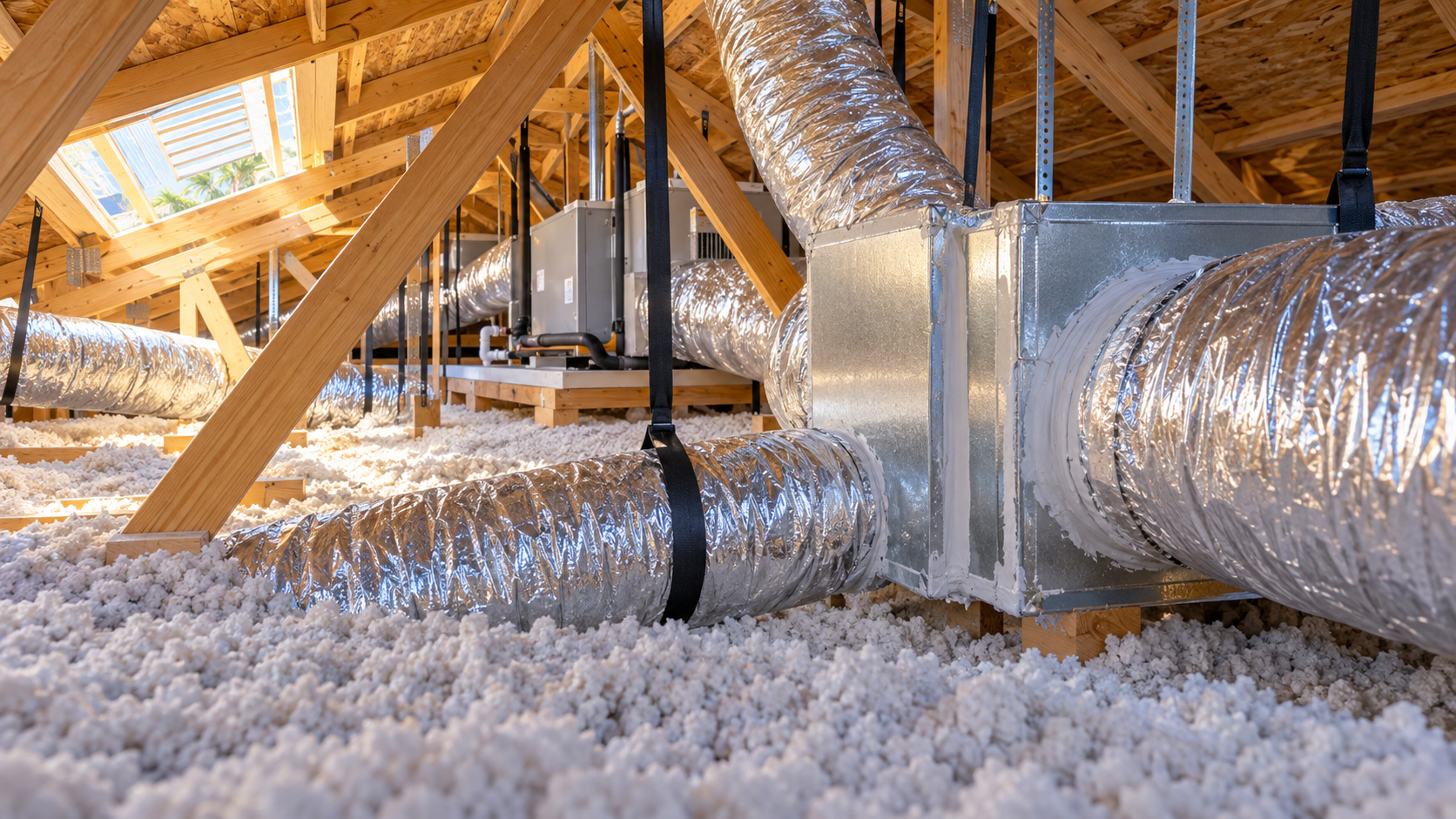
Florida attic with blown insulation, supported insulated flex ducts, sealed supply plenum, and residential air handler
Attic heat becomes an HVAC problem when ceiling insulation, air sealing, or duct insulation and sealing allow heat to reach the conditioned space or cooled air.

A Cooler Home Requires an Insulated, Air-Sealed Ceiling and Protected Ducts

Good attic performance is a system: ceiling penetrations are sealed, insulation is continuous, ducts are supported and sealed, vapor jackets remain intact, and ventilation paths are not blocked.

PROTECT ATTIC HVAC DUCTWORK

Attic Duct Leakage and Damaged Insulation Can Reduce AC Cooling Delivery

Ducts in an unconditioned attic operate in a harsh environment. Supply leakage wastes cooled air, while return leakage can pull hot, humid, dusty attic air into the HVAC system. Torn vapor jackets, compressed insulation, disconnected runs, poor supports, and unsealed plenums can all affect delivered airflow and temperature.

DOE guidance calls for ducts in unconditioned spaces to be sealed and insulated. Inspection should include connections, boots, plenums, supports, vapor barriers, and evidence of condensation. Repair should use compatible duct materials and approved sealing methods rather than household tape.

SUPPLY LEAKAGE

Attic Supply Duct Leaks Waste Cooling

Cooled air escaping into the attic never reaches the intended room and can unbalance the system.

RETURN LEAKAGE

Attic Return Leaks Pull in Heat and Humidity

Negative pressure can draw unconditioned attic air through gaps on the return side.

VAPOR JACKET

Duct Insulation Limits Heat Gain and Condensation

Intact insulation and vapor protection help keep duct surfaces above the attic air’s dew point.

DIAGNOSE THE WHOLE ATTIC SYSTEM

Attic Ventilation Cannot Replace Insulation, Air Sealing, or Duct Repair

Roof and soffit ventilation can help manage roof-deck temperature and moisture in a correctly designed vented attic, but more ventilation is not a universal cure for high cooling bills. Powered attic fans can create pressure effects and may draw conditioned air through ceiling leaks if the air barrier is poor.

When rooms are hot, compare insulation coverage, ceiling air leakage, duct condition, room airflow, solar gain, windows, thermostat operation, equipment performance, and humidity. That measured approach separates an attic problem from an airflow, refrigerant, control, or equipment-capacity problem.

ATTIC TEMPERATURE QUESTIONS

Attic Temperature, Insulation, and AC Cooling Questions

These answers distinguish normal attic heat from conditions that waste cooling or add humidity.

How hot is too hot for a Florida attic?

There is no single temperature that diagnoses a problem. Roof color, sun, ventilation, insulation, duct location, and measurement point matter. Evaluate heat transfer and HVAC performance, not one attic reading.

Will more attic insulation make the AC run less?

It can reduce cooling load when existing insulation is inadequate or uneven, especially when air leaks are sealed. Results depend on the whole building and HVAC system.

Can hot attic air get into HVAC ducts?

Yes. Return-side leakage can pull attic air into the system, and supply leakage can lose cooled air to the attic. Sealed connections and intact duct insulation are important.

Should I install a powered attic fan to help the AC?

Not automatically. A fan can depressurize a leaky attic and pull conditioned air from the home. Inspect air sealing, insulation, and ventilation design first.

PRIMARY HVAC AND INDOOR-AIR SOURCES

Attic Heat and HVAC Sources Used for This Guide

This guide combines building-envelope and HVAC principles so insulation is not treated as a substitute for duct repair or equipment diagnosis.

ARTICLE AUTHORSHIP & TECHNICAL REVIEW

Attic Heat and AC Guide Written and Reviewed by Professionals

This article combines professional research and writing with technical review by the owner of a licensed Palm Beach County HVAC company. The editorial and contractor roles are identified separately so readers can understand how the guidance was prepared.

WRITTEN BY

Senior SEO and Content Specialist at SoFloWeb

Dana is an experienced HVAC content writer who creates clear, useful guidance grounded in careful research and reliable industry sources.

TECHNICALLY REVIEWED BY

Owner, First Degree Air Conditioning
Florida Certified Mechanical Contractor · CMC1250863

Tom reviewed the HVAC guidance for practical accuracy and consistency with real equipment service in Palm Beach County.

This article is educational and does not replace the instructions for the installed equipment or an onsite HVAC evaluation.

PALM BEACH COUNTY ATTIC AND HVAC EVALUATION

Evaluate Attic Insulation, Ductwork, and AC Performance Together

First Degree Air Conditioning can inspect attic insulation conditions, accessible ductwork, airflow, humidity, and system performance before recommending repairs or upgrades.