
FL Lic. #CMC1250863
Florida law addresses manufacturer HVAC warranty registration and transfer, including protections that took effect July 1, 2024. The written warranty still controls coverage, exclusions, and remaining term.
Updated and expanded October 2026 · First Degree Air Conditioning
Florida Statutes sections 559.956 and 559.957 address manufacturer warranties for HVAC systems and components. For qualifying residential property transfers on or after July 1, 2024, an in-effect manufacturer warranty automatically transfers to the new owner without a transfer fee and keeps its remaining term.
Florida also prohibits an offered manufacturer, distributor, or retailer HVAC warranty from being conditioned on product registration. When installed by a contractor licensed under the applicable statute, the full warranty length is effective from installation. This article is general information, not legal advice; review the current statutes and the written warranty for a specific claim.
Use these links to move directly to the information you need.
Separate statutory protections from the specific coverage and exclusions in the warranty document.
Section 559.957 states that an offered manufacturer, distributor, or retailer warranty for an HVAC system or component may not be conditioned on product registration. Registration forms must clearly disclose that failure to return the form does not diminish warranty rights or decrease warranty length.
The statute also states that the full warranty length is effective on the installation date when installed by a contractor licensed under part I of chapter 489. Registration can still help organize product and contact records, but it cannot be used to reduce the offered warranty as prohibited by the statute.
The statutory start point and written warranty both depend on reliable records.
Record every covered system and component without relying on one model number.
Coverage, exclusions, labor, and claim procedures remain document-specific.
Section 559.956 applies when residential real property containing the HVAC system as a fixture is conveyed to a new owner on or after July 1, 2024 and the manufacturer warranty remains in effect. The warranty transfers automatically and continues as if the buyer were the original purchaser.
The warrantor may not charge a transfer fee, and the transfer does not extend the remaining warranty term. Verify that the coverage is a manufacturer warranty within the statute and that the system, component, sale date, and remaining term qualify.
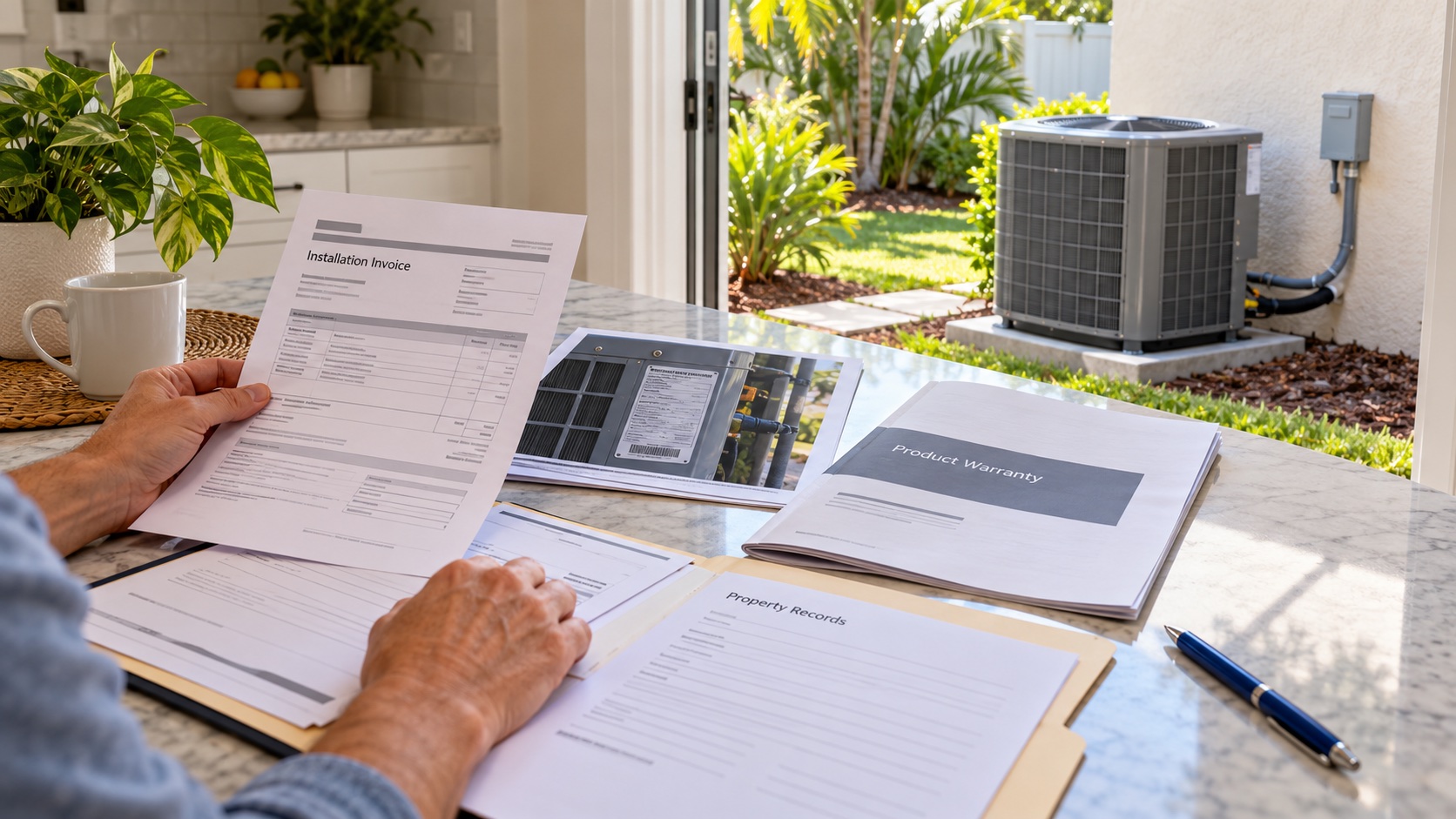
Installation documents, model and serial numbers, written terms, service history, closing records, and claim communications help connect statutory rights to the correct equipment.
Keep the proposal, paid invoice, permit and inspection records, installation date, indoor and outdoor model and serial numbers, certified matched-system information, warranty terms, startup documentation, and maintenance history. Buyers should request these records during the property transaction.
Document changes in ownership, closing date, claim communications, technician findings, and replaced parts. Do not remove equipment labels or discard a failed covered part before the warrantor’s process is understood.
It should identify contractor, address, date, equipment, and scope.
Some warranties require maintenance or exclude failures tied to neglect or outside causes.
The legal transfer is stronger in practice when the new owner can identify the system and coverage.
The statutes do not turn every repair into a covered claim or extend an expired term. Manufacturer parts coverage, contractor labor coverage, service agreements, and home warranties are different obligations with separate exclusions and procedures.
Contact the warrantor or authorized provider, describe the failure, and ask what diagnosis, authorization, proof, shipping, labor, refrigerant, or part-return requirements apply. For a dispute, consult the warrantor, appropriate regulator, or a qualified Florida attorney.
Use these related First Degree Air Conditioning resources to compare the next repair, maintenance, equipment, or operating question without leaving the topic unfinished.
These answers summarize the cited statutes and do not replace legal advice or the written warranty.
Florida section 559.957 prohibits conditioning an offered HVAC warranty on product registration and requires related form disclosures.
For qualifying residential property transfers on or after July 1, 2024, section 559.956 provides automatic transfer of an in-effect manufacturer warranty.
No. The statute says transfer does not extend the remaining term.
No. Coverage, exclusions, labor, refrigerant, maintenance, and claim procedures still depend on the written obligation and applicable law.
The Florida statutes and legislative summary are the controlling starting points. Verify current law and obtain legal advice for a specific dispute.
This article combines professional research and writing with technical review by the owner of a licensed Palm Beach County HVAC company. The editorial and contractor roles are identified separately so readers can understand how the guidance was prepared.
Senior SEO and Content Specialist at SoFloWeb
Dana is an experienced HVAC content writer who creates clear, useful guidance grounded in careful research and reliable industry sources.
Owner, First Degree Air Conditioning
Florida Certified Mechanical Contractor · CMC1250863
Tom reviewed the HVAC guidance for practical accuracy and consistency with real equipment service in Palm Beach County.
This article is educational and does not replace the instructions for the installed equipment or an onsite HVAC evaluation.
First Degree Air Conditioning can provide installation and equipment records for work it performs. Warranty coverage and claims remain subject to the applicable written terms and law.