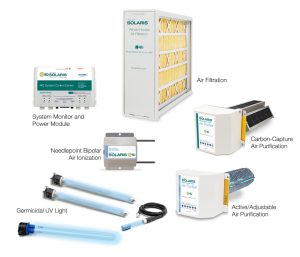
To increase the air-cleaning power of their HVAC systems, many homeowners choose to install UV lights. These germicidal lights help control microbial growth on cooling coils and in ductwork, where moisture and warmth create ideal conditions for harmful mold and bacteria.
But like anything, UV bulbs don’t last forever. Most residential UV-C bulbs operate continuously and last about 9,000 to 12,000 hours or roughly one year.[1] Your bulb may still glow for more than a year, but as it ages, its germ-killing intensity declines.
Understanding UV Lamp Lifespan
The lifespan of an HVAC UV light is influenced by more than just how long the bulb stays illuminated. Factors such as operating hours, system airflow, temperature inside the air handler, and overall HVAC runtime all affect how quickly a UV lamp’s germicidal output declines. Because these lights operate in a humid environment where microbial growth can occur quickly, maintaining consistent UV performance is essential to effectively protect the coil and air handler.
Understanding how UV lamp lifespan is measured helps explain why replacement schedules are based on operating hours rather than whether the bulb still appears to be working. The sections below break down how UV light output changes over time, how HVAC runtime affects performance, and why maintaining proper UV intensity is critical for controlling biological growth inside your system.
Is Replacing My UV Sanitizing Light Once a Year Really Necessary?
Yes — and that’s not just a maintenance upsell. Residential UV-C bulbs don’t typically “burn out” like standard light bulbs. Instead, their ultraviolet output gradually weakens, even if you still see the blue glow.
UV-C light damages microorganisms’ DNA, preventing them from reproducing. That means the light’s intensity, not its visible glow, determines its effectiveness.[2]
Once UV intensity drops below effective levels, mold and bacteria are no longer suppressed at the same rate. Research shows that germicidal effectiveness depends on delivering an adequate UV dose, which declines as lamps age.[3]
In humid climates like Florida, where biological growth can occur quickly inside cooling systems, homeowners should plan to replace their HVAC UV light about once a year to maintain consistent microbial control.
Does How Much I Use My AC Affect UV Lamp Lifespan?
Yes. Runtime is one of the primary factors that determines how long your HVAC UV light lasts. UV bulbs are rated by operating hours, not calendar dates. Because South Florida air conditioners run most of the year to control temperature and humidity, those hours add up quickly.
If your indoor fan is set to “ON” instead of “AUTO,” your UV light may run continuously, even when the compressor is not actively cooling. That increases total runtime and can accelerate output degradation.
According to the CDC, the effectiveness of ultraviolet germicidal irradiation (UVGI) depends on delivering adequate intensity over time, meaning runtime directly influences performance longevity.[4]
In Florida homes where HVAC systems rarely get a break, annual UV light replacement aligns closely with actual operating hours.
Signs Your HVAC UV Bulb May Be Failing or Losing Effectiveness
Because UV output decline is invisible, homeowners often rely on indirect indicators, including:
- Recurring musty odors
- Visible coil fouling during maintenance
- Reduced airflow due to biofilm accumulation
- Increased indoor humidity retention
- Higher static pressure across the coil
Is UV Light Replacement a DIY Job?
Technically, some easily accessible UV bulbs can be replaced by homeowners. But there are important considerations.
UV-C radiation can cause eye and skin injury with direct exposure. The CDC notes that UV-C exposure should be properly shielded and controlled to prevent harm.[4]
Professional replacement ensures:
• The correct replacement lamp type and wattage
• Proper positioning for full coil coverage
• Inspection of ballast and electrical connections
• Safe handling and disposal of mercury-containing lamps
• Confirmation that the system is operating at the intended output
During a scheduled HVAC maintenance visit, technicians can also inspect evaporator coils, airflow, and drainage, all of which work together with your UV light to maintain system cleanliness.
In South Florida’s humid climate, UV light replacement should be part of routine HVAC maintenance, not something you wait to fail. When your HVAC system runs almost year-round, small declines in performance add up. Replacing your UV bulb annually helps maintain consistent microbial control, supports coil efficiency, and protects long-term system performance.
It’s a simple step that keeps your indoor air quality protection working the way it was designed to — especially in a climate where humidity (and your AC) never really take a season off.
Resources:
- MEP Academy Instructor. UV-C Light Explained. MEP Academy [Internet]. Published October 18, 2024. Accessed February 28, 2026. Available from: https://mepacademy.com/uv-c-light-explained/
- Memarzadeh F. A Review of Recent Evidence for Utilizing Ultraviolet Irradiation Technology to Disinfect Both Indoor Air and Surfaces. Appl Biosaf. 2021 Mar 1;26(1):52-56. doi: 10.1089/apb.20.0056. Epub 2021 Mar 19. PMID: 36033964; PMCID: PMC8869636. Accessed February 28, 2026. Available from: https://pmc.ncbi.nlm.nih.gov/articles/PMC8869636/
- Menetrez MY, Foarde KK, Dean TR, Betancourt DA. The effectiveness of UV irradiation on vegetative bacteria and fungi surface contamination. Chemical Engineering Journal [Internet]. (2010) 157;2-3 (p443-450). Accessed February 28, 2026. Available from: https://www.sciencedirect.com/science/article/abs/pii/S1385894709008389
- About Germicidal Ultraviolet (GUV). National Institute for Occupational Safety and Health (NOISH) [Internet]. Published October 04, 2024. Accessed February 28, 2026. Available from: https://www.cdc.gov/niosh/ventilation/germicidal-ultraviolet/index.html