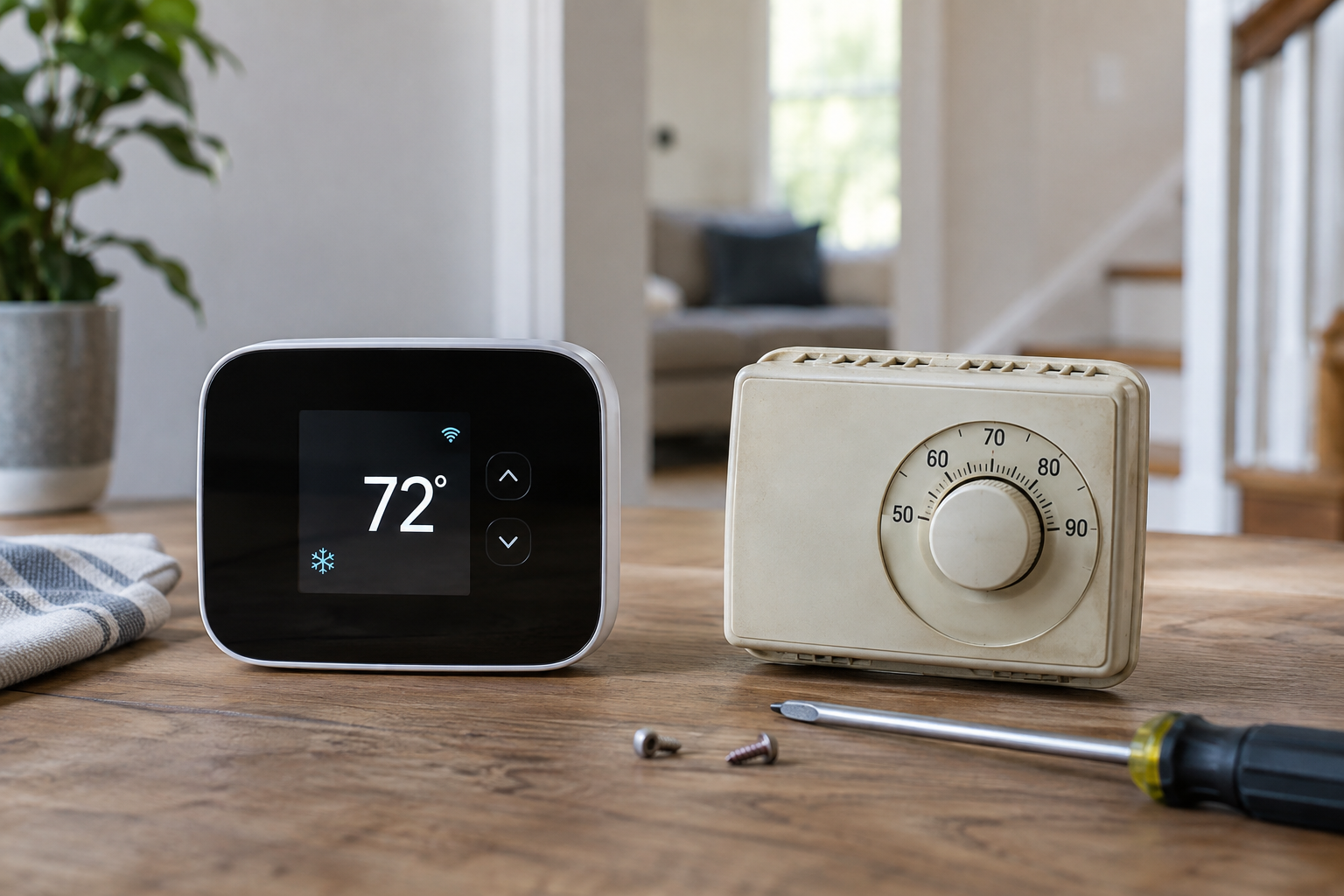
Small but mighty. Your thermostat may be small, but it controls one of the hardest-working systems in your home. Without it, your AC can’t do its job. Thermostats measure the indoor temperature, compare it to your chosen setpoint and tell your air conditioner or heater when to turn on and off. If that reading is inaccurate, your HVAC system may run longer than necessary or shut off before your living space feels comfortable.
Do you still have an older, traditional analog thermostat? If so, you may have wondered whether a modern digital thermostat is more accurate. Let’s look at how both types work, what that accuracy means for your HVAC system and whether it may be time to upgrade.
How Do Digital and Mechanical HVAC Thermostats Work?
Analog thermostats are also called mechanical thermostats. These older controls typically use a bimetallic strip or coil made from two different metals. As the room temperature changes, the metals expand and contract at different rates. That movement opens or closes an electrical contact, signaling the HVAC equipment to start or stop. Some older models use a mercury switch to complete the circuit.[1]
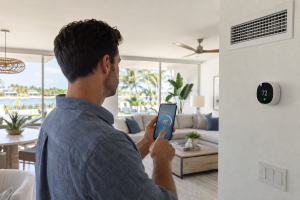
A digital thermostat uses an electronic temperature sensor and a microprocessor instead of relying entirely on moving mechanical parts. The sensor measures the surrounding air, while the thermostat’s internal controls compare that reading to the temperature you selected.
Digital does not automatically mean smart. A basic non-programmable digital thermostat still requires manual adjustments. Programmable thermostats add scheduling, while smart thermostats include features such as Wi-Fi connectivity, remote access and learning capabilities.[2]
Why Are Digital Thermostats Usually More Accurate?
Mechanical thermostats can work reliably for years, but their physical parts may become less precise with age. Dust, corrosion, worn contacts, a sticky mechanism or a thermostat that is no longer level can affect when it calls for cooling or heating.
Digital AC thermostats usually detect smaller temperature changes and react more consistently. That does not mean every digital model is perfect, but it removes some of the guesswork and wear associated with older mechanical controls. A more precise reading also gives your HVAC system better information about when to start and stop. That can make a noticeable difference in how comfortable your home feels.
What Are the Benefits of More Precise Temperature Control?
One or two degrees may not sound like much, but you can feel the difference, especially during a hot, humid Florida summer. More precise control can reduce uncomfortable temperature swings, make thermostat settings easier to understand and help your HVAC system respond more consistently.
Here are some of the practical benefits you may notice:
Smaller Temperature Swings
Every thermostat has a temperature differential, also called a deadband or swing. This is how far the indoor temperature moves from the setpoint before the system responds. A digital thermostat can often maintain a tighter range, so you are less likely to feel warm and sticky before the AC cycles back on.
More Consistent Comfort
In Florida, comfort is not only about the number on the thermostat. Your air conditioner also removes moisture as it runs. More consistent control can help support effective cooling and dehumidification, although a new thermostat cannot fix oversized equipment, poor airflow or leaky ductwork.
Clearer Temperature Settings and Less Confusion
What temperature did you actually choose? A mechanical dial may make it difficult to tell whether you selected 74, 75 or 76 degrees. A digital display provides an exact setpoint and room-temperature reading, making adjustments easier and eliminating the guesswork.
Better HVAC Cycle Control
Some electronic thermostats account for temperature differential, thermal lag, cycle rate and system load. Certain models even calculate how far the room is from the setpoint and how long it has been there. Your technician may refer to this as a control algorithm.[3]
More Opportunities to Save Energy
A more accurate thermostat does not automatically lower your electric bill. Savings come from accurate control paired with practical temperature settings. The U.S. Department of Energy reports that setting the thermostat back 7 to 10 degrees for eight hours daily can save up to 10% per year on heating and cooling.[4]
Can a Digital Thermostat Still Give the Wrong Reading?
Yes. Direct sunlight, nearby appliances, exterior doors, supply vents, and air leaking through the wall can all skew the reading. Thermostats should be installed in a central area away from drafts and heat sources.[5]
If the thermostat says 72 but the room feels much warmer, place an accurate thermometer nearby and compare the readings. An HVAC technician can check the calibration, wiring, cycle-rate settings and system compatibility.
Is It Time to Replace Your Old Mechanical Thermostat with a Digital Version?
You don’t have to rip your old thermostat off the wall and toss it today. But an upgrade may be worth considering if you’ve replaced your HVAC system, noticed cooling inconsistencies or have trouble reading and adjusting the temperature.
Before ordering a thermostat online, check with your HVAC technician. Not every model is compatible with every air conditioner, heat pump, wiring setup or number of heating and cooling stages. The wrong thermostat or incorrect installation can cause performance problems or prevent your equipment from operating properly.
If your system cycles irregularly, the room temperature does not match the display or your mechanical thermostat is showing its age, an HVAC professional can recommend and configure the right digital model. The right control can make everyday comfort much more predictable.
Resources
- Thrive Agency. How Do Old Thermostats Work? Value Controls [Internet]. Published December 17, 2024. Accessed July 27, 2026. Available from: https://value-controls.com/blogs/blog-posts/how-do-old-thermostats-work
- Mayes R. Types of Thermostats: Smart, Programmable & Mechanical Thermostat Guide. Carrier [Internet]. Accessed July 27, 2026. Available from: https://www.carrier.com/us/en/residential/hvac-resources/smart-thermostats/types-of-thermostats/]
- VisionPRO™ 8000 Touchscreen Programmable Thermostat. Resideo [Internet]. Accessed July 27, 2026. Available from: https://customer.resideo.com/resources/Techlit/TechLitDocuments/68-0000s/68-0280.pdf
- Tips on Saving Money and Energy in Your Home. Energy Saver – U.S. Department of Energy [Internet]. Published July 2022. Accessed July 27, 2026. Available from: https://www.energy.gov/sites/default/files/2022-08/energy-saver-guide-2022.pdf
- Busting Common Thermostat HVAC Myths. Trane [Internet]. Published September 26, 2023. Accessed July 27, 2026. Available from: https://www.trane.com/residential/en/resources/blog/busting-common-thermostat-myths/