A restaurant can look spotless and still have an indoor air quality problem. Cooking smoke, airborne grease, moisture, cleaning chemicals and a dining room full of people can all affect the air your employees and customers breathe.
Fortunately, improving restaurant indoor air quality, or IAQ, does not always require replacing your entire commercial HVAC system. The right combination of ventilation, filtration, maintenance and everyday practices can make your restaurant feel fresher and more comfortable.
What Causes Poor Indoor Air Quality in Restaurants?
Frying, grilling and charbroiling can release smoke, grease aerosols, odors, particulate matter and volatile organic compounds (VOCs). Gas-fired equipment may also produce nitrogen dioxide and carbon monoxide. The EPA includes these substances, along with mold and moisture, among common indoor pollutants and IAQ concerns.[1]
Cleaning products, pest-control products and furnishings may add more VOCs. Steam, dishwashing and Florida humidity can contribute to excess moisture.
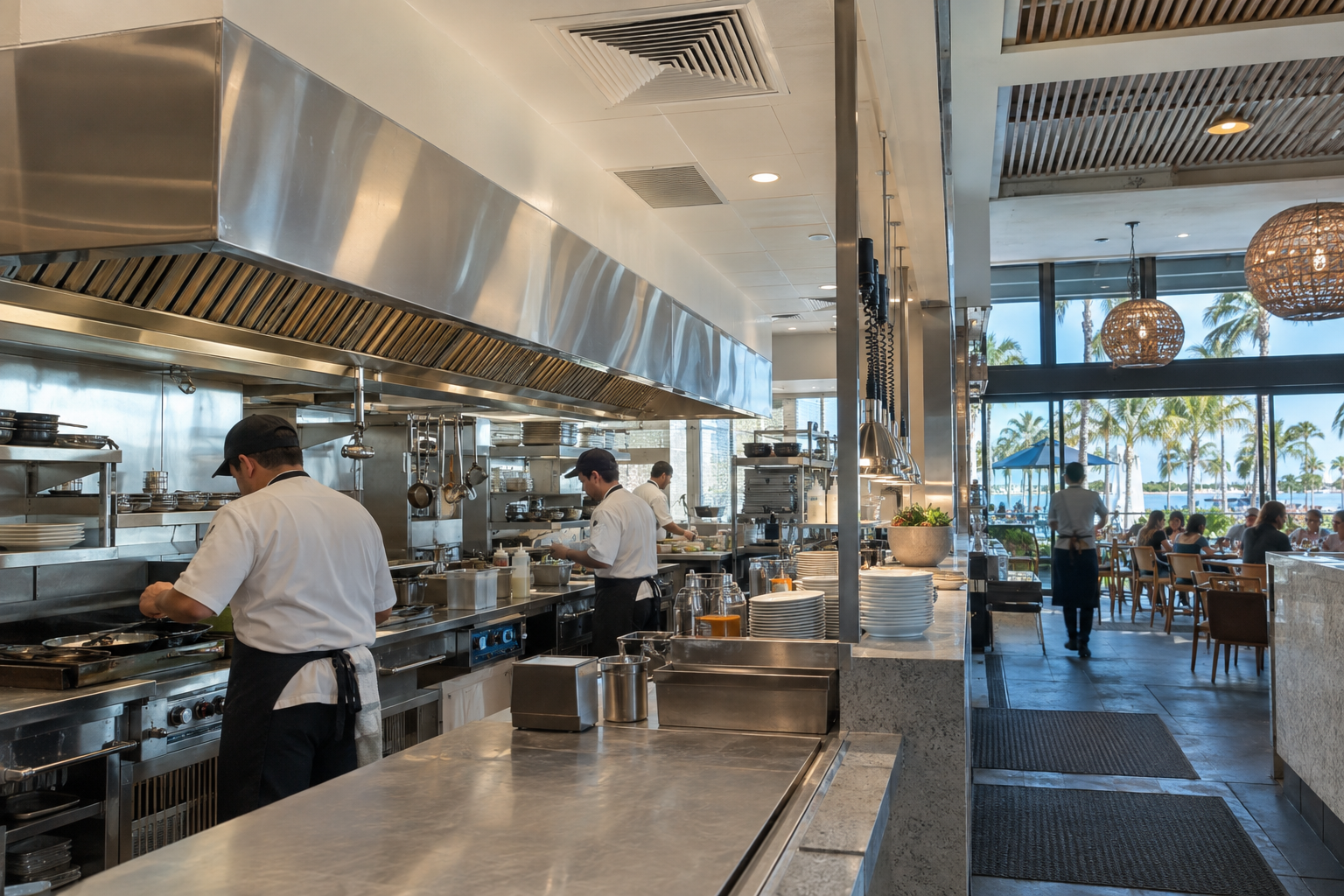
Open kitchens deserve special attention because cooking emissions can move into dining areas. One week-long study found elevated PM2.5 and PM10 in an open-kitchen restaurant’s dining room, even though outdoor levels nearby remained within accepted limits.[2]
Methods to Improve Your Restaurant’s IAQ
Restaurant air quality problems rarely come from one source. A more effective approach combines source control, ventilation, filtration, moisture management and routine maintenance.
Start With a Commercial HVAC and Ventilation Evaluation
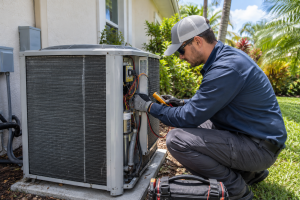
Restaurant HVAC and ventilation are not one-size-fits-all. A commercial HVAC technician can evaluate airflow, outdoor air intake, kitchen exhaust, makeup air, filtration and humidity. This can reveal whether you have an equipment, ventilation or air-balancing problem.
Depending on your restaurant’s layout and cooking equipment, you may need specialized ventilation, exhaust or humidity-control equipment. Work with a commercial HVAC company familiar with restaurant systems and the ventilation, fire, mechanical and local code requirements that may apply.
ASHRAE Standard 62.1 establishes minimum ventilation rates and other IAQ measures for commercial buildings.[3] Your restaurant’s actual requirements may also depend on its size, occupancy, layout, menu and cooking methods.
Capture Commercial Kitchen Contaminants at the Source
Kitchen hoods and exhaust fans should capture heat, smoke, grease and cooking fumes before they spread. The hood must be properly sized and positioned over the equipment. Exhaust systems should operate whenever cooking areas are in use and receive regular cleaning and maintenance.[4]
Balance Kitchen Exhaust and Makeup Air
An exhaust hood removes air, and a makeup air unit, sometimes called an MUA unit, replaces it with filtered outdoor air. Depending on the system, that outdoor air may also be heated, cooled or dehumidified before entering the kitchen. When exhaust and makeup air are not properly balanced, you may notice hard-to-open doors, drafts, a hot kitchen, lingering odors or air entering from unwanted areas.
Air balancing is especially important in open kitchens, where airflow can determine whether cooking emissions remain near the hood or drift toward customers.
Improve Your Restaurant’s HVAC Filtration
The right commercial HVAC filter can help capture dust and smaller airborne particles. However, a higher filter rating is not automatically better. Too much airflow resistance can reduce system performance. Your technician can recommend the highest-efficiency filter your equipment can safely accommodate.
UV-C bulbs may also help with certain IAQ concerns. Properly designed germicidal ultraviolet systems can inactivate certain airborne microorganisms, but they do not remove smoke, grease, particles or VOCs and cannot replace ventilation and filtration.[5]
Control Moisture and Indoor Humidity
Excess humidity can make dining rooms feel sticky, worsen odors and create conditions that allow mold to grow. Have your contractor check cooling performance, condensate drainage, outdoor air settings and dehumidification. Watch for water stains, condensation and musty smells.
Reduce Pollution From Cleaning Products and Smoking
Choose lower-VOC or fragrance-free cleaners when practical, follow label directions and never mix chemicals. Store them in sealed containers away from HVAC returns and food-preparation areas.
Florida Statute 386.204 prohibits smoking and vaping in enclosed indoor workplaces. Florida Statute 386.2045 addresses limited exceptions, including qualifying stand-alone bars.[6]
Monitor Restaurant IAQ and Maintain Your Equipment
Carbon dioxide monitors can reveal patterns that may suggest insufficient outdoor air during busy periods, but CO2 alone does not provide a complete picture of IAQ. Monitoring may also include humidity, temperature, carbon monoxide, VOCs or particulate matter.
Regular maintenance in restaurants is crucial. Replace filters as recommended, keep kitchen exhaust components clean, and schedule HVAC preventive maintenance.
When Should You Schedule a Restaurant IAQ Evaluation?
Lingering odors, uneven temperatures, excessive humidity, frequent condensation or a kitchen that never seems to clear deserve a closer look. Employee or customer comfort complaints may also point to an airflow or ventilation issue.
Keep Your Restaurant Indoor Air Fresh and Let Your Customers Breathe Easier
Clean tables and sanitized surfaces are important, but a comfortable restaurant also needs cleaner, fresher air. That begins with understanding how your kitchen exhaust, makeup air, ventilation and commercial HVAC equipment work together.
If you are noticing lingering odors, uneven temperatures, excessive humidity or a kitchen that never seems to clear, a commercial HVAC evaluation can help identify the source. Addressing airflow, filtration and ventilation problems can create a more comfortable environment for the employees who spend hours inside your restaurant and the customers you want to welcome back.
Resources
- Indoor Pollutants and Sources. EPA – United States Environmental Protection Agency [Internet]. Accessed August 24, 2026. Available from: https://www.epa.gov/indoor-air-quality-iaq/indoor-pollutants-and-sources
- Chang HS, Capuozzo B, Okumus B, Cho M. Why cleaning the invisible in restaurants is important during COVID-19: A case study of indoor air quality of an open-kitchen restaurant. Int J Hosp Manag. 2021 Apr;94:102854. doi: 10.1016/j.ijhm.2020.102854. Epub 2021 Jan 14. PMID: 33776189; PMCID: PMC7979638. Accessed August 24, 2026. Available from: https://pmc.ncbi.nlm.nih.gov/articles/PMC7979638/
- Standards 62.1 & 62.2 – The Standards for Ventilation and Indoor Air Quality. ASHRAE – American Society of Heating, Refrigerating and Air-Conditioning Engineers [Internet]. Accessed August 24, 2026. Available from: https://www.ashrae.org/technical-resources/bookstore/standards-62-1-62-2
- Improving Air Circulation. NIOSH – National Institute for Occupational Safety and Health [Internet]. Published October 03, 2024. Accessed August 24, 2026. Available from:https://www.cdc.gov/niosh/ventilation/prevention/air-circulation.html
- About Germicidal Ultraviolet (GUV). NIOSH – National Institute for Occupational Safety and Health [Internet]. Published October 04, 2024. Accessed August 24, 2026. Available from: https://www.cdc.gov/niosh/ventilation/germicidal-ultraviolet/index.html
- SANITARY NUISANCES; FLORIDA CLEAN AIR ACT – The 2026 Florida Statutes. Online Sunshine – The Florida Legislature [Internet]. Accessed August 24, 2026. Available from: https://www.leg.state.fl.us/statutes/index.cfm?App_mode=Display_Statute&URL=0300-0399%2F0386%2F0386.html