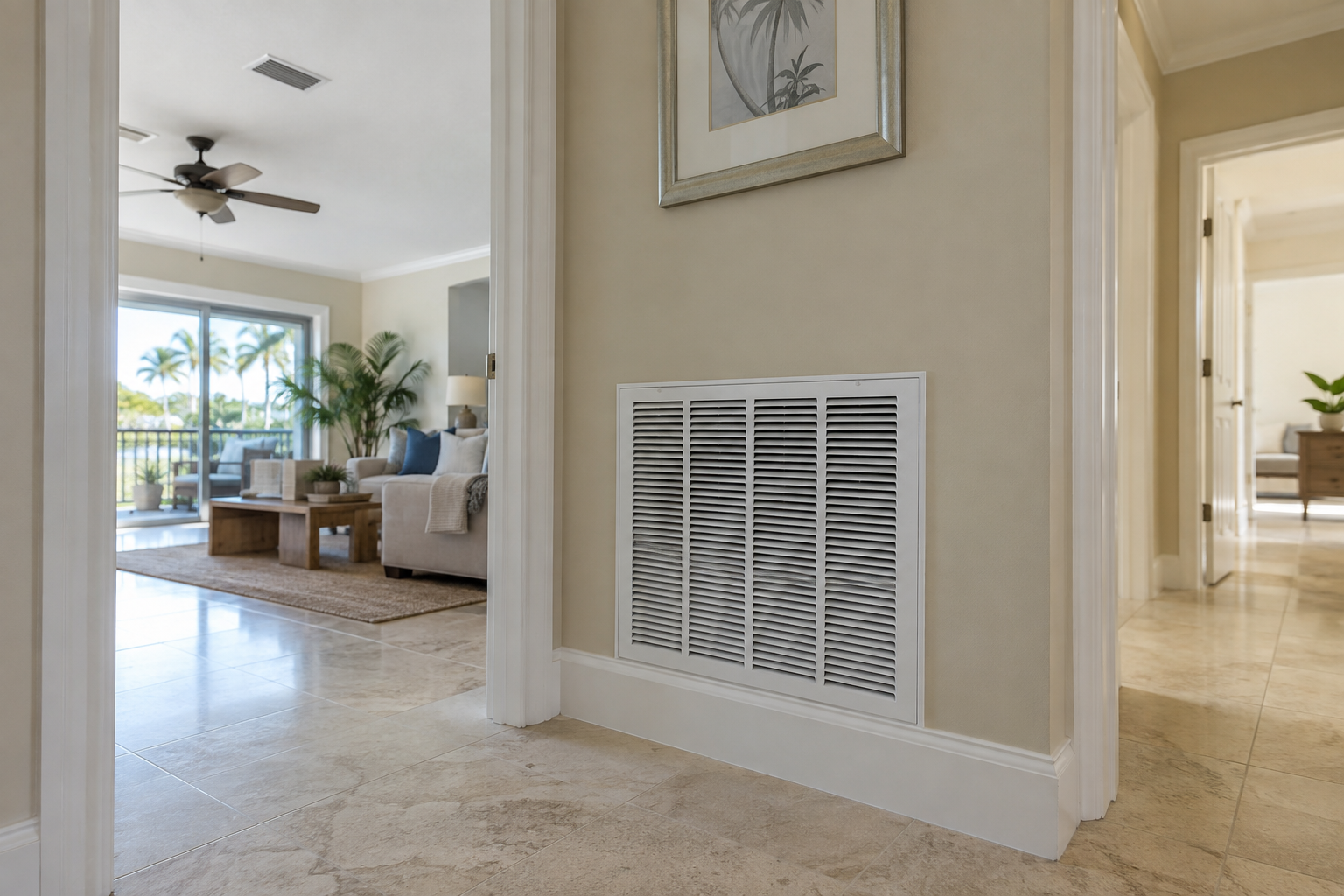
You have probably noticed air blowing from the supply vents when your air conditioner runs. But where does that air go afterward? To keep circulating air through your home, your HVAC system also needs a way to pull it back toward the air handler.
Some older homes were built without dedicated return vents in individual rooms. Others appear to have no returns but rely on one large central grille or another return pathway. If some rooms are hot while others are freezing, your home may lack adequate return airflow. Your existing return may also be undersized, blocked, poorly located, or there may be no properly designed return pathway at all.
Let’s look at whether return vents are necessary, how to determine if your home already has them, and what to do when your AC is not getting enough return air.
Are HVAC Return Air Vents Necessary?
Yes. If your home has central air conditioning, a heat pump or another forced-air HVAC system, the air delivered through the supply vents needs a way to return to the equipment.
However, this does not mean every room needs its own return vent. Some homes use one large central return, while others have several smaller returns. What matters is whether air from each supplied room has an unobstructed path back to the equipment.
What Is the Difference Between Supply and Return Vents?
How do you know if your home even has return air vents?
It can be easy to confuse supply vents and return vents, but there is a simple way to tell them apart.
Hold a sheet of paper in front of each vent while your air conditioner is running. If the paper blows or floats away, it is a supply vent delivering conditioned air into the room. If the paper is pulled toward the grille, it is a return vent drawing air back toward the air handler.
Another clue is size. Return air vents are usually larger than supply vents and may hold an HVAC air filter.
Together, supply and return vents create a continuous loop. The blower must move an adequate volume of air, measured in cubic feet per minute (CFM), through both sides of the system. In a duct system without major leaks or restrictions, the amount of air returning to the equipment should closely match the amount being supplied to the home.[1]
What if you check every vent and cannot find one pulling air in? Your home may use a less obvious return pathway, such as a large hallway grille or a properly designed louvered air-handler closet door. However, if you cannot identify a return and notice any of the problems below, your home’s airflow should be evaluated by an HVAC professional.
What Happens When a House Does Not Have Enough Return Air?
A system that cannot pull enough air back may be described as “starved for return air” or “suffocating.” The home may lack dedicated return vents, or its central grille, return duct or existing pathway may be undersized, blocked or poorly placed.
Here are some common signs that your home may not have enough return airflow:
Uneven Room Temperatures
Bedrooms may feel hot, humid or stuffy while the hallway stays comfortable. The Department of Energy identifies poor circulation and temperature differences as possible results of pressure imbalance.[2]
Interior Doors Move or Become Hard to Close
If a bedroom door moves when the AC starts, supply air may be entering faster than it can escape. A rush of air under the door is another clue that the room lacks a sufficient return pathway.
Your Central Air System Is Loud or Noisy
Whistling at a grille, unusually strong suction or a loud return may point to high static pressure caused by restricted airflow. ACCA Manual D, the industry standard for residential duct design, includes sizing criteria for return grilles, ductwork and door undercuts.[3]
Weak Airflow From the Supply Vents
Your air conditioner may be running, but very little air comes from the supply vents. Without a sufficient return pathway, the blower cannot pull enough air into the system to keep air circulating properly. This can lead to weak airflow, longer cooling cycles and rooms that never reach the temperature set on the thermostat. In severe cases, inadequate airflow may also contribute to an iced evaporator coil.
If My House Needs Return Air, Does Every Room Need a Return Vent?
Not necessarily. A home may work well with one or two central returns if air can travel freely from each supplied room back to the return grille. Bedrooms with closed doors may need dedicated returns, jumper ducts, transfer grilles or properly sized door undercuts to relieve pressure.
Return vents are generally not installed in bathrooms, kitchens or other areas where they could pull excess moisture, cooking odors or contaminants into the system. Proper placement and sizing should be based on the home’s layout, equipment airflow and duct design, not a one-return-per-room rule.
What Should You Do If Your House Has No Dedicated Return Vents?
If your house was built without proper AC return vents, do not assume you need to tear into every wall. An HVAC technician can determine how air is currently returning to the equipment, measure static pressure and airflow, inspect for duct leakage and compare room pressure with doors open and closed.
Your home needs a return-air pathway, but it may not need a return vent in every room. Depending on your home’s layout and existing ductwork, the solution may be a properly sized central return, dedicated return ducts, a transfer grille, a jumper duct or improved door clearance.
A professional HVAC airflow evaluation can determine whether your existing return pathway is enough or whether return vents should be installed. The right solution can improve circulation, reduce hot and cold spots and help your air conditioner cool your home without fighting for air.
Resources
- Fonda A. What is an HVAC Return Air Vent System? Trane [Internet]. Published July 19, 2024. Accessed July 23, 2026. Available from: https://www.trane.com/residential/en/resources/blog/return-air-vent-importance/
- Pressure Balancing Supply and Return Ducts in Existing Homes. Building America Solution Center – US Department of Energy [Internet]. Accessed July 23, 2026. Available from: https://basc.pnnl.gov/information/pressure-balancing-supply-and-return-ducts-existing-homes
- Manual D® – Residential Duct Systems [ANSI/ACCA 1 Manual D – 2016]. Air Conditioning Contractors of America (ACCA) [Internet]. Accessed July 23, 2026. Available from: https://www.acca.org/standards/technical-manuals/manual-d