Mold is such a common problem in South Florida homes that homeowners are always on the lookout for a solution or prevention. Whole-home ionizers may have ended up in your search history if you've noticed musty odors or have concerns about allergies and mold in your HVAC system.
Your question is valid: "If an ionizer helps clean the air, can it get rid of mold too?"
The short answer is no. An air-ionizing purifier can help reduce certain airborne particles (including mold spores), but it can't eliminate an active mold problem. It also cannot remove mold that is already growing in your air conditioning system.
Understanding what today's ionization technology can (and cannot) do will help you choose the best indoor air quality solutions for your home.
How Does an Air Purifier Ionizer Actually Work?
To understand how ionization technology works, it helps to know what an ion is. Don't worry about the science class definition. An ion is simply a tiny charged particle that can attach itself to things like dust, pollen, smoke, and mold spores floating through the air.[1]
An ion generator releases electrically charged particles, called ions, into the air.
Once charged, the particles become heavier and are more likely to:
- Clump together
- Settle onto surfaces
- Be captured by your HVAC filter
Some whole-home air purification systems use bipolar ionization technology as part of a larger indoor air quality strategy. Research has shown that ionization can modestly improve particle removal in some indoor environments, particularly when used alongside filtration systems rather than as a standalone solution.[2]
However, mold is more than just airborne spores.
Why Ionization Technology Can't Remove Mold
Mold grows when spores land on a damp surface and find the moisture they need to multiply. Once mold begins growing on drywall, insulation, ductwork, coils, drain pans, or other building materials, an ionizer cannot remove it.
According to the CDC and EPA, controlling moisture is the most important step in preventing and addressing mold problems.[3; 4]
Even if an ionizer helps reduce some airborne spores, it does not:
- Remove mold colonies
- Fix water leaks
- Lower excessive humidity by itself
- Clean contaminated HVAC components
- Replace mold remediation
Think of it this way: capturing some of the seeds floating through the air does not remove the weeds already growing in the garden.
Moisture control first. Air cleaning second.
So, How Can I Prevent Mold in My Air Conditioning System?
If your goal is mold prevention, focusing on moisture control and system maintenance is far more effective than relying on a single air-cleaning device.
Here are some tips to help prevent mold from taking hold in your home:
Control Indoor Humidity
The CDC recommends keeping indoor humidity at 50% or lower whenever possible.[3] High humidity creates ideal conditions for mold growth, especially in Florida's wet and warm climate.
If your home consistently feels damp or sticky, a dedicated whole-home dehumidifier may provide more mold-prevention benefits than an air-cleaning device alone.
Something Stinks: If your home smells musty every time the AC runs, don't assume the odor is coming from your ductwork. Evaporator coils, drain pans, clogged condensate lines, high indoor humidity, and even hidden water damage can all contribute to mold-related odors. .
Keep Your Air Conditioner Maintained
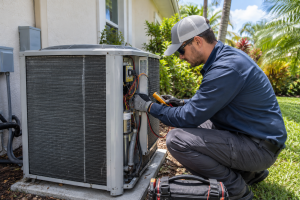
Routine HVAC maintenance helps identify clogged drain lines, dirty evaporator coils, excessive condensation, and airflow issues before they lead to moisture problems.
Upgrade Your AC Filter
The type of air filter you choose does make a difference. The right HVAC filter for your home and system can help capture mold spores and other airborne contaminants before they circulate through your home.
Address Water Problems Quickly
Leaks, flooding, roof issues, plumbing problems, and condensation should be corrected as soon as possible. Mold can begin growing surprisingly fast when moisture is present.[3; 4]
Already Have Mold? If mold growth covers a large area, keeps returning, or is linked to a water damage event, cleaning it yourself may not be enough. The EPA recommends professional remediation for larger mold problems. In some cases, a mold remediation or environmental services company may need to address the contamination before your HVAC contractor can fully optimize your indoor air quality.
Are Ionic Air Purifiers Worth It for Mold Concerns?
Active mold infestations? No. But an HVAC air ionizer may provide some benefits as part of a broader indoor air quality system. Depending on the technology, it may help reduce airborne particles and improve overall air cleanliness.[2]
However, homeowners should be cautious about marketing claims that suggest ionizer filters "kill mold" or completely solve mold problems. The EPA notes that ionizers primarily affect airborne particles and may be less effective for larger particles than other air-cleaning technologies.[5]
Even if mold spores are inactive, dead mold particles can still contribute to allergy symptoms and respiratory irritation in some individuals.[3; 4] The mold growth itself also remains unless it is properly removed.
Some ionization and air-cleaning products may generate ozone as a byproduct, so it is important to choose certified products and discuss options with an HVAC professional.[6; 7]
What Homeowners Should Remember About Ionizers and Mold
If mold is already growing in your home or HVAC system, an air ionizer is not a substitute for fixing the underlying problem. Mold requires moisture, so the real solution is to identify and correct the source of that moisture while properly cleaning or remediating affected areas.
That does not mean ionization technology has no value. When paired with proper filtration, humidity control, and routine HVAC maintenance, a whole-home ionizer is just one tool that helps improves indoor air quality. The key is understanding its role. It can help manage airborne particles, but it cannot remove mold growth on its own.
If you're considering a whole-home ionizer or another indoor air quality upgrade, talk with a trusted HVAC professional before making a decision. Not all air-cleaning technologies work the same way, and some systems have a stronger real-world track record than others. An experienced HVAC technician can help you compare proven options, explain the benefits and limitations of different brands and models, and recommend the best solution for your home's specific air quality concerns. Depending on your needs, that may be a whole-home ionizer, upgraded filtration, UV technology, humidity control, or a combination of systems working together.
Resources
- Nunez K. How Does an Air Ionizer Work? Healthline [Internet]. Published August 29, 2021. Accessed May 27, 2026. Available from: https://www.healthline.com/health/what-does-an-ionizer-do
- Romay FJ, Ou Q, Pui DYH. Effect of Ionizers on Indoor Air Quality and Performance of Air Cleaning Systems. Aerosol and Air Quality Research (AAQR) [Internet]. 2024; 21(1). Accessed May 27, 2026. Available from: https://aaqr.org/articles/aaqr-23-10-oa-0240
- Mold Clean Up Guidelines and Recommendations. CDC [Internet]. Published February 16, 2024. Accessed May 27, 2026. Available from: https://www.cdc.gov/mold-health/about/clean-up.html
- A Brief Guide to Mold, Moisture and Your Home. EPA [Internet]. Updated February 18, 2026. Accessed May 27, 2026. Available from: https://www.epa.gov/mold/brief-guide-mold-moisture-and-your-home
- What are ionizers and other ozone generating air cleaners? EPA [Internet]. Updated February 18, 2026. Accessed May 27, 2026. Available from: https://www.epa.gov/indoor-air-quality-iaq/what-are-ionizers-and-other-ozone-generating-air-cleaners
- Guide to Air Cleaners in the Home – 2nd Edition: Portable Air Cleaners, Furnace and HVAC Filters. EPA [Internet]. Updated February 17, 2026. Accessed May 27, 2026. Available from: https://www.epa.gov/indoor-air-quality-iaq/guide-air-cleaners-home
- List of CARB-Certified Air Cleaning Devices. California Air Resources Board (CARB) [Internet]. Accessed May 27, 2026. Available from: https://ww2.arb.ca.gov/list-carb-certified-air-cleaning-devices