It's no secret that summer in Florida is hot. Daily temperatures in the 90s can easily come with a "feels like" temperature well over 100 degrees, thanks to the humidity. When that happens, it's only natural to want to crank the thermostat down and stay cool. But how cool should your house be when it's a scorcher outside?
If your AC seems to be running constantly on a hot afternoon, you may start wondering whether something is wrong. The reality is that air conditioners do have limits, and in South Florida, they're often pushed closer to those limits than systems in milder climates.
Understanding how your AC is designed to perform can help you set realistic expectations, stay comfortable, and avoid unnecessary strain on your system.
Does My Air Conditioner Have a Cooling Limit?
In a way, yes.
Most residential air conditioning systems are designed to maintain indoor comfort, not create refrigerator-like temperatures when outdoor conditions are extreme. HVAC professionals often refer to the "20-degree rule" or "temperature split" when discussing cooling performance.
This rule of thumb suggests that a properly functioning AC system will typically cool the air passing through it by about 15 to 20 degrees Fahrenheit between the return and supply air. Let's clear up the confusion, though: that does not mean your house can only be 20 degrees cooler than the outdoor temperature.
Whole-home temperature is affected by many factors, including insulation, air leakage, humidity, sun exposure, ductwork condition, and system sizing.[1; 2]
So, how cool should your house be when it's 90°F outside?
Here's the honest answer: if it's 90 degrees outside and your AC is in good working condition, it should be able to maintain a comfortable indoor temperature, often somewhere in the mid-70s. Exactly how cool your home feels will depend on factors like humidity levels, insulation, sun exposure, air leakage, and your thermostat setting.
During the hottest part of the day, however, your system may need to run longer to keep up. If outdoor temperatures climb into the upper 90s or triple digits, even a properly functioning air conditioner may start approaching its cooling limits.
What's the Recommended Thermostat Setting in Summer (And Won't I Be Warm?)
There is no single "perfect" thermostat setting because comfort varies from person to person. No two homes, families, or HVAC systems are exactly alike, either.
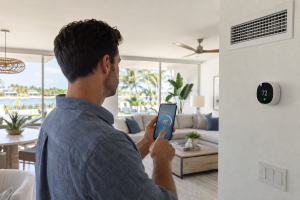
That said, 78°F is the thermostat setting most commonly recommended by energy experts when you're home and need cooling. It offers a good balance between comfort, energy efficiency, and system performance. Adjusting your thermostat by 7 to 10 degrees for about 8 hours per day can reduce annual heating and cooling costs by up to 10%.[3; 4]
But what if 78 degrees feels too warm? You're not alone. Many Florida homeowners are most comfortable somewhere between 72 and 76 degrees, especially during the most humid months of the year.
It's also important to remember that 78°F indoors does not feel the same as 78°F outdoors. Inside your home, the air conditioner is removing humidity, there is little to no direct sun exposure, and air is continuously circulating. Outside, higher humidity, solar heat, and limited air movement can make the same temperature feel much hotter.
Just keep in mind that your air conditioner is the hardest-working appliance in your home. Every degree you lower the thermostat increases the workload on your system because it must maintain a larger temperature difference between your home and the outdoor air. On the flip side, energy experts estimate that raising the thermostat by just one degree in summer can reduce cooling costs by up to 3%.[3; 5]
A Few Things That Affect Your AC’s Cooling Performance
Even the best air conditioner can struggle if other parts of the home are working against it. That's why two homes sitting side by side can have completely different comfort levels and energy bills, even if they're set to the same thermostat temperature.
Several factors affect how efficiently your home holds onto cool air and how hard your AC has to work to maintain the temperature you've set.
Humidity Levels
Florida humidity makes homes feel warmer than the actual temperature. A house at 76 degrees with high humidity often feels less comfortable than a house at 78 degrees with proper moisture control.
Pro Tip: Before lowering your thermostat by a few more degrees, check your indoor humidity level. A home at 76°F with 45-50% humidity often feels more comfortable than a home at 72°F with excess moisture in the air.
Insulation and Air Leaks
Poor attic insulation, leaky windows, and gaps around doors allow heat to enter your home, increasing the cooling load on your HVAC system.
Ductwork Problems
Leaky, damaged, or poorly insulated ducts can waste conditioned air before it ever reaches your living spaces.
Direct Sunlight
Large west-facing windows and rooms with significant sun exposure naturally gain more heat throughout the day.
Shade and Landscaping
Trees, awnings, shade screens, and covered patios can significantly reduce heat gain around your home. Homes with little shade often place a heavier cooling demand on the air conditioner during the hottest part of the day.
System Maintenance
Dirty filters, clogged coils, low refrigerant, and other maintenance issues can reduce cooling efficiency and make your AC work harder than necessary.
Pro Tip: If your AC seems to struggle only during the hottest part of the day but cools normally overnight, don't automatically assume you need a new system. Dirty coils, restricted airflow, low refrigerant, or duct leaks often reveal themselves when summer temperatures put the heaviest demand on your equipment.
What If My House Won't Get Below 80 Degrees?
If it's 90°F outside and your home won't cool below 80, especially during the late afternoon or after sunset, it may be time to call in the HVAC pros.
While extreme heat can challenge any system, consistently poor cooling performance may point to issues such as:
- Low refrigerant
- Dirty evaporator or condenser coils
- Restricted airflow
- Duct leakage
- Incorrect system sizing
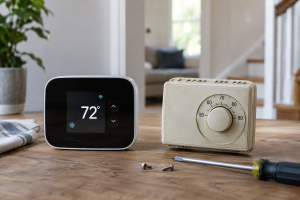
- Thermostat problems
- Aging equipment
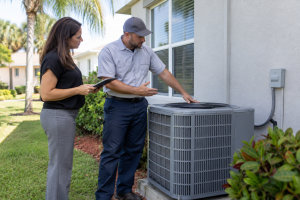
An HVAC technician can measure temperature split, airflow, refrigerant performance, and overall system operation to determine whether your system is performing as designed.
My House Is Warm: Is It the Florida Heat or Is There a Problem with My AC?
When it's 90 degrees outside, most properly functioning air conditioners should be able to maintain a comfortable indoor temperature, often somewhere in the mid-70s. The exact number depends on factors like your home's insulation, humidity levels, sun exposure, ductwork, and thermostat settings.
If your home feels comfortable, your energy bills seem reasonable, and your system is maintaining a steady temperature, your AC is probably doing exactly what it was designed to do. If it's running nonstop, struggling to reach the thermostat setting, or leaving parts of the house feeling warm and humid, it may be time to have it checked by an HVAC professional.
It's also worth remembering that summer heat often exposes problems that were easy to miss during milder weather. A system that seemed to be cooling just fine in spring may struggle once temperatures and humidity climb because small issues suddenly become much harder for the equipment to overcome.
Sometimes the issue is simply Florida heat being Florida heat. Other times, a maintenance issue, airflow problem, or aging component may be preventing your system from performing at its best.
Resources
- Atkins M. A Split in Diagnosis. Air Conditioning Contractors of America (ACCA) [Internet]. June 10, 2020. Accessed May 28, 2026. Available from: https://hvac-blog.acca.org/a-split-in-diagnosis/
- Orr B. Why the 20° Rule is Driving the Internet Crazy. HVAC School – For Techs by Techs [Internet]. Published June 01, 2019. Accessed May 28, 2026. Available from: https://www.hvacrschool.com/why-the-20-rule-is-driving-the-internet-crazy/
- Programmable Thermostat. U.S. Department of Energy [Internet]. Accessed May 28, 2026. Available from: https://www.energy.gov/energysaver/programmable-thermostats
- A Guide to Energy-Efficient Heating and Cooling. Energy Star – EPA [Internet]. Accessed May 28, 2026. Available from: https://www.energystar.gov/sites/default/files/asset/document/HeatingCoolingGuide%20FINAL_9-4-09_0.pdf
- Energy Tips for Commercial Buildings. Department of Energy and Environment (DOEE) [Internet]. Accessed May 28, 2026. Available from: https://doee.dc.gov/service/energy-tips-commercial-buildings