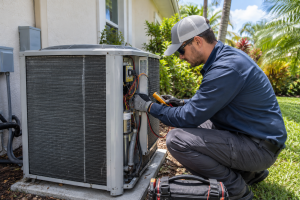
If your AC seems to quit on you every summer, you’re not imagining it, and you’re definitely not alone. Summer is when HVAC companies get the most service calls for air conditioners that quit mid-season.
There’s a reason it always happens when you need it most. Summer doesn’t just make your home hotter; it pushes your entire HVAC system to its limits. And if anything is even slightly off, that’s when it shows up.
Most “sudden” breakdowns aren’t actually sudden. They’ve been brewing for a while.
Summer Heat Is Harder on Your AC
Your air conditioner doesn’t just cool air. It also removes heat and humidity simultaneously. And in places like Florida, that second part is a big deal. On really humid days, your system can use a significant portion of its capacity just pulling moisture out of the air; sometimes before it even starts lowering the temperature.[1]
That means:
- Longer run times
- Higher energy use
- More wear on components
Humidity alone can reduce your AC’s effectiveness, even if nothing is technically “broken.” So when your HVAC system struggles in summer, it’s not always failing; it’s being pushed harder than usual.
Signs of Trouble: Why Your Air Conditioning Works Fine (Until It Doesn’t)
A lot of homeowners say the same thing: “It was working yesterday.” That’s because mild weather hides problems. Small issues, like low refrigerant, dirty coils, or airflow restrictions, might not show up when it’s 80°. But once temperatures climb into the 90s (with humidity to match), your system has no margin left.
Here are a few examples of issues that strain your HVAC system:
Low Refrigerant: Less Cooling Power When You Need It Most
When refrigerant levels are low, your system can’t absorb and move heat effectively. It might still run, but it won’t cool like it should, especially during peak summer heat when demand is highest.
Dirty Coils: Heat Gets Trapped Instead of Released
Your system relies on clean coils to transfer heat out of your home. When they’re covered in dirt, dust, mold and sticky buildup, that heat has nowhere to go, and your AC starts to struggle or overheat.
Weak Electrical Components: Seemed Fine Until the Workload Increased
Capacitors, contactors, and other electrical parts can wear down over time. They may still work during mild weather, but under the longer, heavier cycles of summer, they’re often the first things to fail.
All of these can cause your AC to run constantly without cooling or to shut down altogether when it overheats.
The Wrong Size AC Problem Most People Don’t Realize
Here’s one that surprises many homeowners: bigger isn’t always better. Proper system sizing matters because your system has to manage both temperature and humidity loads, not just cool the air.[1]
If your AC is oversized, it cools your home too quickly and shuts off before removing enough humidity. That leads to that cold-but-clammy feeling and more strain on the system over time.
On the flip side, an undersized system will run nonstop trying to keep up. Either way, improper sizing creates stress, and summer is when that stress turns into breakdowns.
Airflow Issues Are a Quiet Problem Until Summer Temps Soar
Your AC depends on consistent airflow to do its job. When airflow is restricted—often because of missed maintenance, dirty filters, blocked vents, or duct issues—your system can’t effectively move heat out of your home. [2]
Restricted airflow can lead to:
- Frozen coils (yes, even in summer)
- Cooling issues
- Overheating components
And once airflow is compromised, everything else has to work harder to compensate.
Why AC Breakdowns Tend to Happen in Summer (Not Spring)
Your system just isn’t prepared for the level of demand it’s under when the Florida summer ramps up. In a climate like Florida, where heat and humidity stay high for long stretches, your AC is working harder and longer than it would in milder conditions.[3]
During peak summer:
- Your system runs longer cycles
- Outdoor temperatures are higher
- Indoor humidity is higher
- Crucial components like the fan motor, capacitor and compressor stay under constant load
This combination accelerates wear and exposes weaknesses fast. Systems that were “getting by” in spring can’t keep up anymore.
That’s why HVAC companies are busiest during heat waves. Your system didn’t just break; it finally gave out under pressure, unable to keep up with the heat.
What You Can Do to Stop the Cycle of Summertime AC Problems
If your AC goes out every summer, the goal isn’t just to fix it; it’s to break the pattern.
A few simple changes go a long way:
- Change your air filter regularly (especially in peak season)
- Schedule a pre-summer tune-up to keep your system running at peak performance when temperatures climb.
- Keep outdoor units clean and clear of debris.
Pay attention to early warning signs like weak airflow, strange noises or longer run times.
Pro Tip: If your system is older, struggling to cool, or your energy bills and repair costs keep creeping up, it might be time to take a closer look at whether it’s properly sized—or just nearing the end of its lifespan.
Summer AC Breakdowns and Costly Repairs
An air conditioner that fails every summer isn’t a personal attack. It’s a sign your system is struggling under the weight of extreme Florida conditions and a heavy workload.
It’s no secret that summer heat and humidity push your system to work harder, longer, and less efficiently. If there’s any weakness, such as airflow issues, low refrigerant, system age, or incorrect sizing, it will show when you need cooling the most.
This year, don’t wait until the inevitable happens and you’re left frustrated and sweaty because your AC is down. Before temperatures ramp up, schedule a preventive maintenance appointment and let your HVAC tech know about any past issues.
They can conduct a full inspection and help you take proactive steps to ensure your system is ready for summer. A little attention now can save you from a breakdown later.
Resources:
- Importance of Air Conditioning. U.S. Department of Energy [Internet]. Accessed March 28, 2026. Available from: https://www.energy.gov/energysaver/air-conditioning
- Indoor Air Quality (IAQ). EPA – United States Environmental Protection Agency [Internet]. Accessed March 28, 2026. Available from: https://www.epa.gov/indoor-air-quality-iaq
- Fairey P, Parker D, Vieira R, Martin E. Vent Right and Then? Mechanical Ventilation, Dehumidification and Energy Use in Humid Climates. Florida Solar Energy Center [Internet]. August 19, 2014. Accessed March 28, 2026. Available from: https://www.fsec.ucf.edu/en/publications/pdf/FSEC-PF-460-14.pdf