
FL Lic. #CMC1250863
Check the thermostat first, then confirm accessible power controls, airflow, and condensate safety conditions without opening energized HVAC equipment.
Updated and expanded April 2026 · First Degree Air Conditioning
When the AC stops working, start at the thermostat. Confirm that it has power, is set to COOL, and has a temperature setting below the current indoor temperature. If the thermostat uses replaceable batteries, follow its instructions before assuming the HVAC equipment has failed.
Then check only the controls and conditions that are safe and visible: the air filter, the indoor equipment service switch if clearly labeled, the outdoor disconnect if it has not been disturbed, the home breaker panel, supply and return grilles, and any accessible condensate float-switch indication. Never remove electrical panels or touch capacitors, contactors, wiring, or refrigerant components.
Use these links to move directly to the information you need.
Use these steps in order and stop when a check requires opening equipment, repeated breaker resets, refrigerant work, or electrical diagnosis.
Set the system to COOL and the fan to AUTO unless the equipment instructions specify otherwise. Lower the setpoint a few degrees below room temperature and allow the system its normal startup delay. A blank display may indicate batteries, a loss of low-voltage power, a tripped safety device, or another control problem.
If a smart thermostat recently lost power, Wi-Fi, or configuration, verify that it still recognizes the correct equipment type. Do not remove the thermostat or move wires unless you are qualified and the system is safely de-energized.
HEAT, OFF, or an incorrect schedule can prevent a cooling call even when the room feels warm.
The setpoint must be below the measured room temperature before the thermostat will normally call for cooling.
Many thermostats and condensers use a short anti-short-cycle delay after a setting or power change.
Look for a tripped HVAC breaker and confirm that a clearly labeled indoor service switch has not been turned off. The outdoor disconnect should remain fully seated and closed; do not remove covers or handle exposed components.
If the breaker trips again after one safe reset allowed by the equipment guidance, stop. Repeated resets can worsen an electrical fault and remove important diagnostic evidence. Carrier and Trane troubleshooting guidance both direct homeowners toward basic power checks while reserving repeated trips and internal electrical work for qualified service.
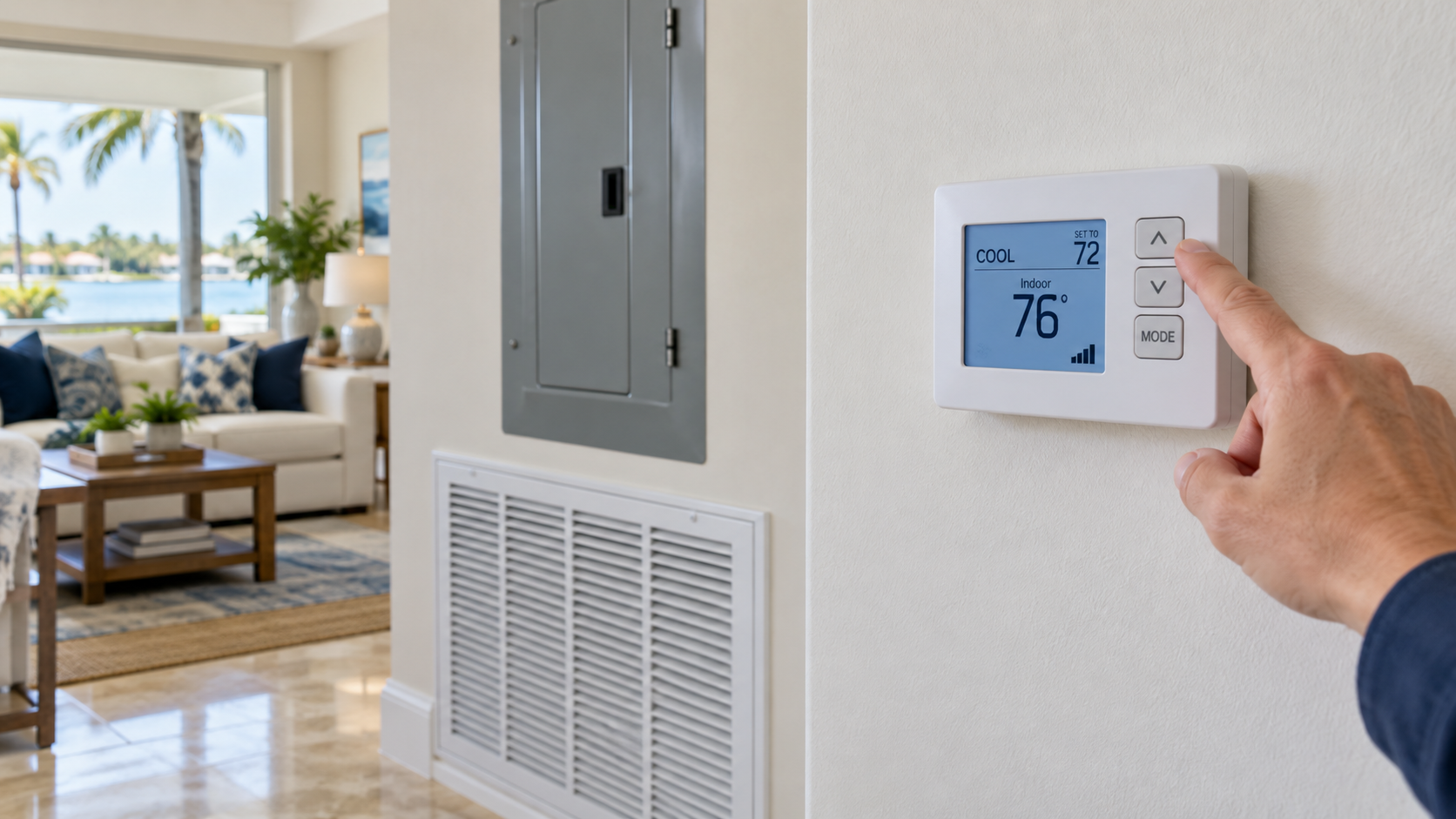
Thermostat settings, a filter, labeled switches, a breaker position, and visible water are homeowner observations. Capacitors, contactors, wiring, and refrigerant circuits require trained service.
Inspect an accessible filter and replace it if it is heavily loaded, using the correct dimensions and airflow direction. Confirm that return and supply grilles are open and unobstructed. A severely restricted system may freeze, and turning cooling back on before the ice melts and the cause is corrected can compound the problem.
In Florida, a clogged condensate drain may raise a float switch and shut down the equipment to prevent overflow. Do not bypass the switch. Water around the air handler, a full auxiliary pan, or a recurring drain fault requires drainage service and inspection of the equipment.
A dirty filter can reduce airflow, but replacing it will not repair a frozen coil or blower fault already present.
Blocked returns and closed supplies can disrupt airflow and room balance.
A float switch may stop cooling because condensate is not draining safely; never bypass it.
Schedule service when the breaker trips again, the outdoor unit hums without starting, the indoor blower does not run, ice forms, water leaks, the float switch repeats, controls display a fault, or the system runs without cooling. Burning odors, smoke, arcing, or damaged wiring require immediate shutdown and appropriate emergency help.
A technician can test electrical components, airflow, controls, static pressure, refrigerant performance, drainage, and temperature change. That diagnosis is safer and more useful than replacing parts based only on the symptom that the AC will not turn on.
These answers cover common first checks without encouraging unsafe electrical or refrigerant work.
The system may be in a startup delay, a safety switch may be open, power may be missing at one component, or an equipment fault may be preventing operation.
A single reset may be appropriate when the breaker is clearly identified and equipment guidance allows it. If it trips again, stop and schedule service.
Yes. A properly installed float switch can interrupt cooling when condensate backs up. Do not bypass the switch; correct the drainage problem.
Turn cooling off, avoid chipping the ice, and arrange diagnosis. A loaded filter, airflow fault, blower problem, or refrigeration issue may be responsible.
These sources support safe first checks while keeping internal electrical and refrigerant diagnosis within qualified service.
This article combines professional research and writing with technical review by the owner of a licensed Palm Beach County HVAC company. The editorial and contractor roles are identified separately so readers can understand how the guidance was prepared.
Senior SEO and Content Specialist at SoFloWeb
Dana is an experienced HVAC content writer who creates clear, useful guidance grounded in careful research and reliable industry sources.
Owner, First Degree Air Conditioning
Florida Certified Mechanical Contractor · CMC1250863
Tom reviewed the HVAC guidance for practical accuracy and consistency with real equipment service in Palm Beach County.
This article is educational and does not replace the instructions for the installed equipment or an onsite HVAC evaluation.
First Degree Air Conditioning can test the thermostat, electrical controls, airflow, condensate drainage, refrigeration performance, and equipment operation.