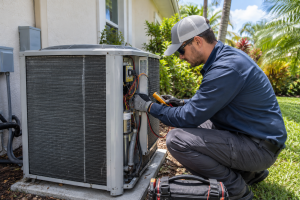
Have you ever gone upstairs only to find it feels like a heatwave while downstairs is cool and comfortable? It’s one of the most common complaints in two-story homes here in South Florida.
Multi-level homes naturally deal with a few cooling challenges that single-story homes don’t. And while heat rising is part of the story, it’s usually not the whole reason your upstairs feels warm and stuffy. The good news? There are real, fixable causes behind that temperature difference, and ways to get your whole home feeling more balanced again.
Causes of Uneven Temperatures in Two-Story Homes
If this has been driving you crazy, here’s the part most homeowners don’t realize: it’s rarely just one issue causing that hot upstairs and cold downstairs feeling.
Heat rise plays a role, but there are usually other factors at work, like poor airflow, poor ductwork, missing insulation, and how your system is set up to cool your home. That’s why turning the thermostat down doesn’t always fix it. Your AC might be doing exactly what it’s designed to do; it’s just not evenly distributing that cool air between floors.
Heat Rises
Let’s start with the obvious one that you probably already know. Warm air naturally rises, and cooler air sinks. That’s basic physics, but in your home, it creates a real comfort problem.
As your AC runs, it cools the lower level first. Meanwhile, heat builds up upstairs, especially if your roof and attic are absorbing the Florida sun all day. That trapped heat doesn’t just disappear; it lingers, making your second floor feel warmer no matter how low you set the thermostat.
This effect is called thermal stratification, and it’s a big reason why multi-story homes struggle with uneven temperatures.[1; 2]
Why Your HVAC System Struggles to Cool Upstairs
Not all residential HVAC systems are designed to handle temperature differences between floors.
If you have a single system controlling both levels, it’s likely using one thermostat and guess where that’s located? Downstairs. So once your lower level hits the set temperature, the system shuts off… even if it’s still hot upstairs.
That’s not a broken AC. It’s a control issue. If your system wasn’t properly sized or designed for a two-story layout, it may never fully balance the two floors, especially in summer. Oversized systems can short-cycle (turn on and off too quickly), while undersized ones may run nonstop without keeping up.[3]
Common Airflow Issues That Hinder Cooling in Multi-Story Homes
Even if your system is functioning, poor airflow can disrupt the cooling process.
Here are a few common culprits:
- Leaky or poorly designed ductwork
- Closed or blocked vents
- Dirty air filters that restrict airflow
- Weak return air pathways upstairs
If cool air isn’t reaching the necessary areas or warm air isn’t being properly pulled back, you’ll definitely notice the difference. Duct losses alone can account for 20–30% of energy use in a typical system, meaning much of the cooled air may never reach your upstairs rooms.[4]
How Attics Make Upstairs Spaces Hot
In Florida, attics can reach temperatures of 120 to 150°F during the summer. This heat then radiates down into the second floor throughout the day. If your attic insulation is inadequate or your home isn’t properly air-sealed, your upstairs will be continually reheated from above, even while your air conditioning is running.
Homeowners often notice significant improvements by upgrading their insulation or sealing gaps in the attic. This reduces heat transfer and helps your air conditioning maintain a consistent temperature for longer.
Quick Things You Can Try to Help Your AC Cool Upstairs
Before jumping into bigger upgrades, there are a few simple adjustments that can help:
- Set your thermostat fan to “on” instead of “auto” to keep air circulating
- Partially close some downstairs vents to push more air upstairs
- Make sure all vents upstairs are fully open and unblocked
- Replace dirty air filters
- Use ceiling fans upstairs to improve air movement
These aren’t permanent fixes, but they can take the edge off while you figure out the bigger picture to ensure more balanced cooling.
HVAC Solutions To Balance Temperatures Across Your Home
Temperature imbalances between floors can be frustrating, indicating that your HVAC system may need a more targeted approach. Here are several effective solutions to consider for resolving these inconsistencies:
Zoning Your System: By controlling each floor separately with its own thermostat or sensor, you can create distinct comfort areas. This targeted approach helps maintain even temperatures throughout your home rather than trying to cool it all at once.
Enhancing Airflow: Improving duct design or sealing any leaks can improve airflow, helping balance temperatures between levels.
Adding Insulation: Addressing issues such as attic heat gain and improving insulation can prevent unwanted heat from entering living spaces, especially in warmer climates.
Installing Separate Systems: For homes with significant size or two-story layouts, having dual systems (one for each floor) may already be in place. If one floor remains uncomfortable, it might indicate that the second unit needs servicing or is underperforming.
Considering Ductless Mini-Split Systems: If the upstairs isn’t cooling adequately, mini-splits can alleviate the load on your main system without requiring a total HVAC overhaul.
Before raising your thermostat settings to cool your home, assess your HVAC system and home setup. The solution isn’t always about colder air; it’s about ensuring consistent airflow and a properly functioning system.
If you’ve exhausted DIY fixes without success, it may be time to consult an experienced HVAC professional. They can accurately diagnose issues with ductwork, insulation, or zoning, ensuring your home feels uniformly comfortable and creating a cohesive environment where both floors remain inviting.
With the right adjustments and professional guidance, you can put an end to temperature inconsistencies and enjoy a balanced living space where your upstairs feels just as cool as your downstairs.
Resources:
- Air Sealing Your Home. U.S. Department of Energy [Internet]. Accessed April 26, 2026. Available from: https://www.energy.gov/energysaver/air-sealing-your-home
- Swanson R. Impacts of Thermal Stratification on Building Comfort, Cost and Product Integrity. KW Engineering [Internet]. Accessed April 26, 2026. Available from: https://kw-engineering.com/thermal-stratification-hvac-building-comfort-energy-cost/
- Central Air Conditioning. U.S. Department of Energy [Internet]. Accessed April 26, 2026. Available from: https://www.energy.gov/energysaver/central-air-conditioning
- Duct Sealing. Energy Star [Internet]. Accessed April 26, 2026. Available from: https://www.energystar.gov/saveathome/heating-cooling/duct-sealing